What Is a High School Diploma Called? Diploma, GED, HiSET
07
OCT
What Is a High School Diploma Called? Diploma, GED, HiSET
In the United States, the document you receive when you finish high school is called a high school diploma. It is not a "degree" — degrees are awarded by colleges and universities — and it is not the same as a GED, a HiSET or a certificate of completion, even though all four are often lumped together as "finishing high school." This guide explains what each document is called, who issues it, what it proves, how to replace it if yours is lost, and where a novelty replica fits in.
The short answer
- High school diploma — issued by a school or school district to a student who completed the state's graduation requirements. The standard credential.
- GED — a high school equivalency credential earned by passing the GED test, administered by GED Testing Service; the credential itself is issued by the state.
- HiSET — a second high school equivalency test, administered by ETS and accepted in a smaller group of states.
- Certificate of completion (or attendance) — given to students who finished the required years or coursework but did not meet every graduation requirement; it is not a diploma.
People also say "high school degree," "secondary school diploma," "grade 12 certificate" and "senior certificate." In US usage all of these mean the high school diploma; the first is common in speech but technically incorrect, and the last two are mostly used outside the US.
High school diploma: who issues it and what it shows
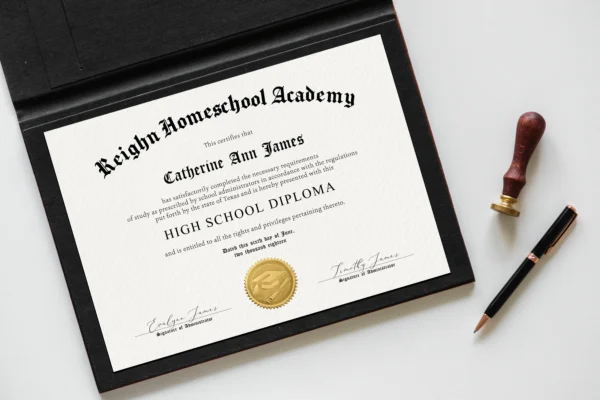
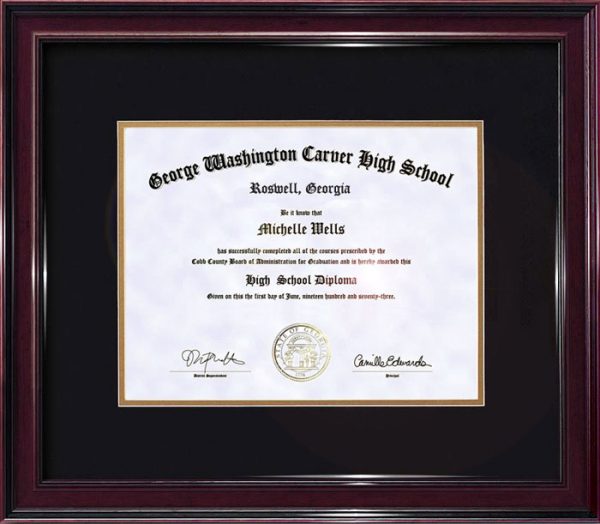
A high school diploma is awarded by the school (or the district or state board that oversees it) once a student has earned the required credits, passed any state-mandated exams and met attendance rules. Requirements are set state by state, which is why a diploma from Texas and a diploma from New York can represent slightly different course loads. The document itself is simple: the school's name and location, the student's name, a statement that the student has completed the course of study prescribed by the state or district, the date, the school seal and the signatures of the principal and a district official. Many schools print "High School Diploma" as the heading; some print "Diploma" and name the program ("Academic Honors Diploma", "Advanced Studies Diploma") on the line below.
What it proves to the outside world is that the issuing school certifies graduation. A transcript — the record of courses and grades — is a separate document and is what most colleges and some employers actually ask for.
GED: a test, then a state-issued credential
"GED" originally stood for General Educational Development and is now simply the trademarked name of the test. A candidate who passes the four GED subject tests (language arts, math, science and social studies) receives a high school equivalency credential. The important detail is who issues it: the test is run by GED Testing Service, but the credential — called a High School Equivalency Diploma, Certificate of High School Equivalency or similar depending on the state — is issued by the state's department of education. That is why a GED certificate from Florida and one from Michigan look different. Details on the test, eligibility and how scores are reported are on the official GED site.
HiSET: the other equivalency test
The HiSET exam, administered by ETS, covers the same five subject areas (reading and writing are split) and leads to the same state-issued equivalency credential in the states that offer it. Some states use only the GED, some only the HiSET, and some offer both; a few have their own test. A HiSET passer does not receive a "HiSET diploma" — they receive their state's high school equivalency credential, and can request a score transcript from the HiSET program (HiSET scores and credentials).
Certificate of completion: finished, but not graduated
A certificate of completion (in some states a certificate of attendance or certificate of achievement) is issued to a student who completed four years or the required coursework but did not satisfy every graduation requirement — most often a state exit exam, or, for students on an individualized education program, a modified curriculum. It records participation rather than graduation. Colleges and the military generally do not treat it as a diploma, and holders are usually eligible to sit the GED or HiSET to earn an equivalency credential.
Side by side
| Document | Issued by | Earned by | What it proves |
|---|---|---|---|
| High school diploma | School / district / state board | Completing the state's graduation requirements | Graduation from high school |
| GED credential | State department of education (test by GED Testing Service) | Passing the four GED tests | High school equivalency |
| HiSET credential | State department of education (test by ETS) | Passing the five HiSET sub-tests | High school equivalency |
| Certificate of completion | School / district | Finishing coursework or years without meeting every requirement | Attendance / participation |
Replacing a lost document
Each document has a different custodian, so the replacement route differs:
- Diploma: contact the high school's main office or the school district's records department. If the school has closed, the district or the state education agency usually holds the records. Our guide to getting a copy of your high school diploma walks through the steps.
- GED / HiSET credential: request it from the state office that issued it, not the school; score transcripts come from GED Testing Service or ETS.
- Certificate of completion: the school or district that issued it.
If you never completed high school, the equivalency route is covered in ways to obtain a high school diploma or equivalent.
Where a novelty replica fits
When the official copy is unavailable — the school has closed and the records are gone, the state office cannot locate the file, or the original was destroyed and you want something for the wall while the replacement request works its way through — a novelty high school diploma printed with your name, school and graduation date fills the display gap. The same applies to a novelty GED diploma. Both are replicas for display, gifts and props: they are not credentials, they do not come with any record behind them, and they cannot be used as proof of graduation. If you want to see what the finished document looks like, what a high school diploma looks like shows the layout element by element.
How to read a diploma, GED or certificate when you see one
Because the four documents are often shown side by side — in a job file, a college application or a frame on a wall — it helps to know what each one physically looks like. A high school diploma is a single page, letter size or slightly smaller, with the school's name in large type, the student's name, the graduation statement, the date and two or three signatures over a seal. A state equivalency credential (GED or HiSET route) looks similar but is headed by the state's department of education rather than a school, carries the state seal, and is titled "High School Equivalency Diploma" or "Certificate of High School Equivalency." A GED or HiSET score report is not decorative at all: a tabular printout of subject scores, test dates and pass status. A certificate of completion usually resembles a diploma in layout but says "Certificate of Completion" or "Certificate of Attendance" in place of "Diploma" and omits the graduation statement.
The fastest check is the heading and the issuer line. "Diploma" plus a school name means graduation. "Equivalency" plus a state department name means a GED or HiSET route. "Completion" or "Attendance" means the student finished without meeting every requirement.
Frequently asked questions
Is a GED the same as a high school diploma?
No. A GED credential certifies high school equivalency, earned by examination; a diploma certifies graduation from a school. Most colleges and employers accept either.
What is a "high school degree"?
It is the everyday name for a high school diploma. Strictly, degrees are college-level awards; high schools issue diplomas.
Who signs a high school diploma?
Typically the principal and a district official such as the superintendent or school board president; some states add a state education officer.
Sources
- GED Testing Service — official site
- HiSET — Get Your Scores & Credentials
- Federal Trade Commission — College Degree Scams (why equivalency "shortcuts" are a warning sign)