What Does a GED Certificate Look Like? State vs Transcript
23
OCT
What Does a GED Certificate Look Like? State vs Transcript
A GED certificate does not come from GED Testing Service. It comes from the state where you passed the test, which is why two GED credentials from different states look different — and why there is no single "GED diploma" design. What the test provider issues is a score transcript; what the state issues is a high school equivalency diploma or certificate. This guide explains what each document looks like, who issues it, how to replace one, and where a novelty GED diploma fits.
Two documents, two issuers
| State high school equivalency credential | GED score transcript | |
|---|---|---|
| Issued by | Your state's department of education (or its designated agency) | GED Testing Service |
| Looks like | A diploma-style certificate: state seal, your name, "High School Equivalency Diploma / Certificate," date, official signatures | A one- or two-page report: your scores by subject, pass status, test dates, candidate ID |
| Used for | Framing; proof of equivalency where a diploma is requested | College admissions, employers and the military who want scores |
| How to get another | Request from the state agency that issued it | Order through your GED account (GED Testing Service) |
What the state credential looks like
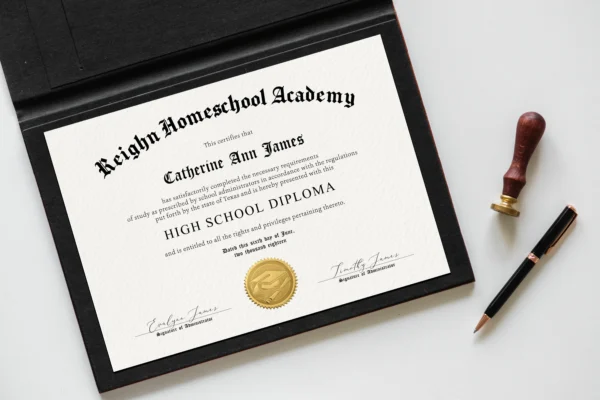
Most states issue a document in the same proportions as a high school diploma — letter size or slightly smaller — with these elements:
- The state's name and department ("State of Texas, Texas Education Agency," for example) and usually the state seal.
- The credential's title. This varies: "High School Equivalency Diploma," "Certificate of High School Equivalency," "State High School Diploma" or, in a few states, "GED Diploma." The title on your document is set by your state's law, not by the test.
- Your name, as recorded at testing.
- The statement of equivalency — wording to the effect that the holder has demonstrated achievement equivalent to a high school graduate by passing the state-approved examination.
- Date of issue and sometimes the testing center or county.
- Signatures of state education officials — commonly the commissioner or superintendent of education and a program director.
Older credentials (before the 2014 test revision, and in states that have since switched providers) may carry different wording, and some states issued wallet cards alongside the certificate.
What the GED score transcript looks like
The transcript is a plain report rather than a decorative document: candidate name and ID, the date and location of each test, scores for Reasoning Through Language Arts, Math, Science and Social Studies, the pass threshold, and any college-ready or college-ready-plus-credit designations. It is what admissions offices and employers actually ask for when they say "send your GED." States that use the HiSET exam instead issue the same kind of state credential, with the scores held in your HiSET account (HiSET scores and credentials).
Replacing a lost GED certificate
Because the state issues the credential, the state replaces it — not GED Testing Service and not your old testing center. Each state's education department has a request process, usually a form, an ID check and a small fee. The score transcript is replaced separately through the test provider. Our step-by-step guide is how to replace a lost GED diploma, and the wider picture of what "GED" means next to a diploma is in what a high school diploma is called.
Where a novelty GED diploma fits
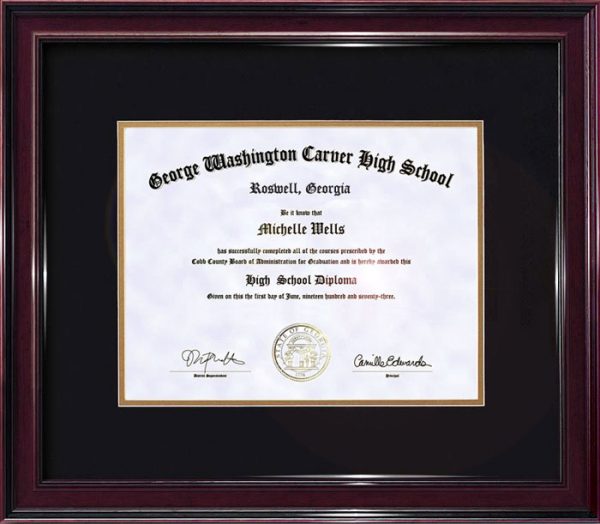
A novelty GED diploma is a replica in the diploma style — the school name, city and state, your name and graduation date on a secondary-school layout with a gold foil seal — for framing, gifts and props. It is not a state credential: it carries no record, cannot be used as proof of equivalency, and is not a score transcript. It is made for the wall while the state processes a replacement, for a gift to someone who earned their GED years ago, or for a prop. The same applies to the novelty high school diploma; the design elements of that document are shown in what a high school diploma looks like.
Why states, not the test provider, issue the credential
High school equivalency is a state responsibility. Each state decides which test or tests it accepts (GED, HiSET or its own), sets the passing standard, and issues the credential under its own name. GED Testing Service administers the exam and holds the scores; it has no authority to confer a diploma. The practical consequences follow from that split: your certificate is replaced by the state, your scores are replaced by the test provider, and an employer who wants to verify your GED should be pointed to the state or to the score transcript, not to a certificate on the wall.
Variations you may see
- Title. "High School Equivalency Diploma," "Certificate of High School Equivalency," "State High School Diploma," "High School Equivalency Certificate" and, in a few states, "GED Diploma."
- Size and finish. Most are letter size on cover-weight stock with a printed state seal; some states emboss the seal; a few issue a smaller certificate with a separate wallet card.
- Signatures. Usually the state's chief education officer and the equivalency program director; occasionally the governor.
- Older versions. Credentials issued before the 2014 GED revision, or under a previous state provider, may carry different wording and the older test name.
What a novelty GED diploma reproduces — and what it does not
A novelty GED replica reproduces the certificate layout: the state heading, the title, your name, the date, a gold foil seal fused onto the document, and signature lines signed with our made-up in-house signatures or left blank for you to sign. It does not reproduce a state record, a candidate ID or a score, and it is not a transcript. It is made for the same reasons as a Perfect Match Diploma: a frame, a gift, a prop, or a stand-in while the state processes a replacement. If what you need is proof of equivalency, the state and the score transcript are the only sources.
Frequently asked questions
Does the GED certificate say "GED" on it?
Some states' credentials do; many say "High School Equivalency." The word is a trademark of the test, and states choose their own title.
Is the GED transcript the same as the certificate?
No. The transcript reports scores and comes from the test provider; the certificate is the state's credential.
Can a novelty GED diploma replace my state certificate?
For the wall, yes; for any official purpose, no — only the state can reissue the credential.
Sources
- GED Testing Service — official site (test content, scores, transcripts)
- HiSET — Get Your Scores & Credentials