Official vs Unofficial Transcript: Differences and Uses
19
OCT
Official vs Unofficial Transcript: Differences and Uses
An official transcript is a copy of your academic record issued directly by the school, sealed or digitally certified, and sent to the recipient so that it cannot be altered along the way. An unofficial transcript is the same record printed or downloaded by you, with no seal and no chain of custody. The grades are identical; what differs is who can trust it. This guide explains the difference, when each is accepted, how to request both, what to do when the school no longer exists, and where a novelty transcript fits.
The difference, in one table
| Official transcript | Unofficial transcript | |
|---|---|---|
| Issued by | The school's records office (or its ordering partner) | You, from the student portal, or a plain copy from the school |
| Format | Sealed envelope with signature across the flap, or a certified PDF with a verification code | Printout or PDF, often watermarked "unofficial" |
| Sent to | Directly to the receiving institution or employer | Yourself, or anyone you forward it to |
| Cost | Usually a small per-copy fee | Usually free |
| Accepted for | Admissions, transfer credit, licensing, employment verification | Advising, preliminary applications, your own records |
| What makes it "official" | The school certifies it and controls delivery | Nothing — it is a convenience copy |
What both documents contain
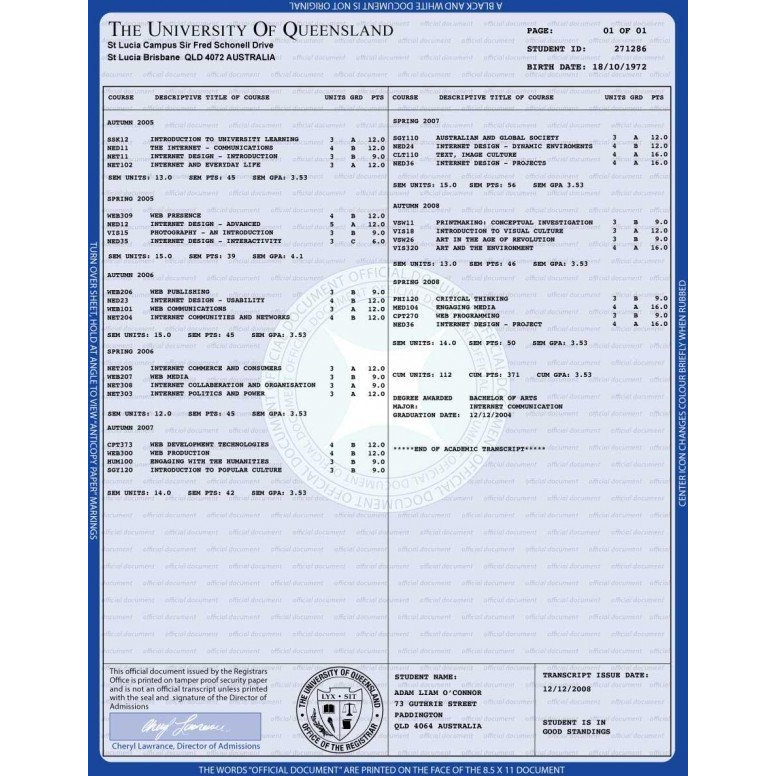
Official or not, a transcript lists the courses you took, term by term, with credit hours and grades; your cumulative GPA; degrees or certificates awarded with their dates; and often transfer credit, honors, academic standing and the school's grading key. The school's name, your name and student ID (sometimes partially masked) and the date of issue appear at the top. Our guide to what a transcript looks like walks through the layout.
When each is accepted
Official transcripts are required whenever the recipient needs certainty: college and graduate admissions, transfer of credit, professional licensing boards, employers that verify education, immigration and scholarship applications. The recipient wants the document to come from the school, not from you.
Unofficial transcripts are enough for advising appointments, checking your own progress, early-stage job applications where a recruiter just wants to see coursework, and as a placeholder while the official copy is in transit. Many graduate programs accept an unofficial copy with the application and require the official one only on enrollment.
How to request an official transcript
- Find the school's transcript page. Most US colleges route requests through their records office website or through a national ordering service such as the National Student Clearinghouse (which also handles verifications for employers).
- Confirm your identity. Expect to provide your name at the time of attendance, date of birth, student ID or Social Security number fragment, and dates attended.
- Choose delivery. Electronic (certified PDF to the recipient's email) is fastest; paper copies are mailed sealed. If you need a copy for yourself, order it addressed to you — it stays official only while the envelope is sealed.
- Clear any holds. Schools can withhold transcripts for unpaid balances; a hold must be resolved before release.
Your right to see your own record comes from FERPA, the federal student-privacy law, which gives students the right to inspect their education records (what FERPA is). It does not oblige a school to issue an official copy while a legitimate hold exists.
How to get an unofficial transcript
Current and recent students can usually download one from the student portal. Alumni without portal access can ask the records office for an unofficial copy by email, which most schools provide free. How to get unofficial college transcripts covers the common portals and what to do if yours has been deactivated.
When the school has closed
Records from closed colleges are transferred to a custodian — a successor institution, the state's higher-education agency or a records-storage service. State education departments publish where each closed school's records went; New York's list is one example (transcripts from closed colleges). If you cannot get the record at all, what if I can't get my college transcripts sets out the remaining options.
Where a novelty transcript fits
A novelty transcript — for example a bachelor's transcript printed from your own course list or one assembled for your major — is a replica for display, props and personal files. It is neither official nor unofficial in the sense above, because there is no school record behind it: it cannot be sent as an official copy, and it cannot be verified. It is the right choice for a film set, a gift or a wall display; it is not a substitute for the school's record.
Reading the two formats side by side
Lay an official and an unofficial transcript from the same school next to each other and the content is identical line for line. What differs is the wrapper. The official copy carries the school's seal (embossed or printed), the signature or printed name of the records officer, the date of issue, a statement such as "This is an official transcript when it bears the seal of the university," and, for electronic copies, a certification page with a verification code the recipient can check on the issuing service's site. Many schools print official transcripts on security paper with a hidden "COPY" pattern that appears when photocopied. The unofficial copy has none of this; most portals stamp "UNOFFICIAL" diagonally across each page so it cannot be mistaken for the sealed version.
Common problems and how to solve them
- A hold on the account. Unpaid tuition, library fines or an unreturned laptop can block official copies. Pay or dispute the hold first; unofficial copies are usually still available.
- Name change since graduation. Order under the name on the record and include the current name on the request; the transcript will show the name at the time of attendance unless the school has updated it.
- The school merged or renamed. Records transfer to the successor; request from the successor's records office and mention the former name.
- Attendance decades ago. Older records may be on microfilm or paper; allow extra time and expect a paper copy rather than an electronic one.
- The recipient says the electronic copy "expired." Certified PDFs often carry a validity window; reorder and ask the recipient to open it promptly.
Transcript, diploma, degree verification — which do you actually need?
A transcript shows courses and grades. A diploma is the ceremonial document; it proves nothing on its own and is rarely requested by institutions. Degree verification is a yes/no confirmation that a degree was awarded, which employers obtain through the school or the Clearinghouse without any document from you. If a request says "proof of degree," ask which of the three they mean before paying for an official transcript you may not need.
Frequently asked questions
Can I make an unofficial transcript official?
No. Only the school can issue an official copy. Opening a sealed official transcript makes it unofficial.
Do official electronic transcripts expire?
Many certified PDFs carry a validity window for the verification link; the recipient should open it promptly.
Does an employer need an official transcript?
Some do; most verify the degree through the school or the National Student Clearinghouse and ask for a transcript only for specific roles.
Sources
- US Department of Education — What is FERPA?
- New York State Education Department — Transcripts from Closed Colleges
- National Student Clearinghouse — Education Verifications