High School Diploma From a Closed School: How to Get a Copy
30
OCT
High School Diploma From a Closed School: How to Get a Copy
When a high school closes or merges, its student records do not disappear — by law they are transferred to a custodian, usually the school district, a successor school or the state education agency. Getting a copy of your diploma or transcript means finding that custodian. This guide gives the order to search in, what to send with the request, how long to allow, and what to do while you wait or if the records are truly gone.
Step 1: start with the district, not the school
A closed school's records almost always go to the school district that ran it. Search for the district by the town or county where the school was, then look for "student records," "transcript requests" or "alumni records" on the district site. If the district itself was dissolved or merged, the receiving district holds the records. California's Department of Education, for example, keeps a Student Records & Transcripts page that points former students to the right custodian, including the custodian of records listed for private schools that have closed.
Step 2: the successor school
If two schools merged, the surviving school's main office usually holds both sets of records. Ask for the records function by its local name — guidance office, records clerk, student services — and give the old school's name and the years you attended.
Step 3: the state education agency
When no district or successor exists — private schools that closed, charter schools that surrendered their charter, schools in districts that were abolished — the state education department is the custodian of last resort. New York, for instance, requires the private career schools it licenses to hand their student transcripts to the state when they close, and publishes how former students request them (NYSED — obtaining closed school student records). Most states have an equivalent page; search "[state] department of education closed school records."
Step 4: private and parochial schools
- Parochial schools: records typically go to the diocese or the religious order's education office.
- Private schools: to the state education agency, or to a named successor if the school was absorbed.
What to send with the request
Every custodian asks for roughly the same things: your full name at the time of attendance (maiden name if it has changed), date of birth, the school's name and city, the years attended and year of graduation, a copy of photo ID, your signature authorizing release (the federal student-privacy law, FERPA, gives you, from age 18, the right of access to your own education records and control over how they are disclosed), the mailing or email address for delivery, and the fee if there is one. Allow several weeks; state archives can take longer than districts. Note that what you will receive is normally a transcript or a letter confirming graduation; many districts no longer reprint the diploma itself.
While you wait, or if the record is gone
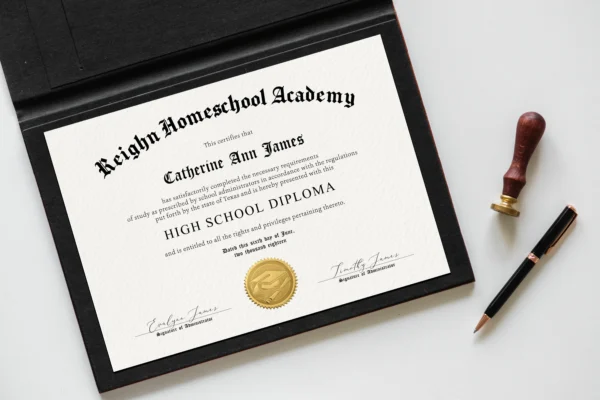
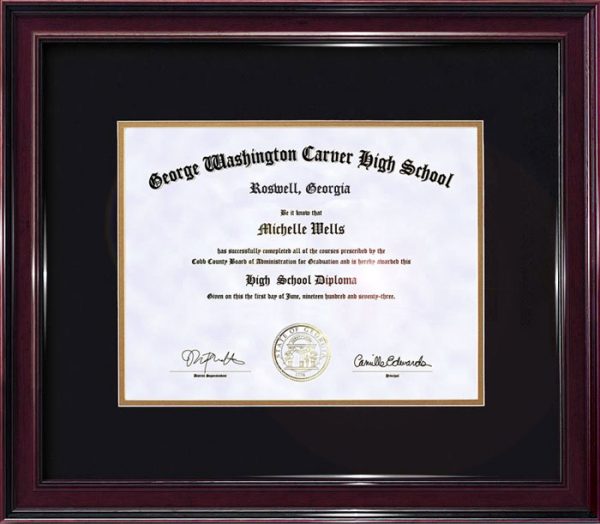
Records do go missing — floods, fires, mergers where boxes were never transferred. If the custodian confirms there is no record, your options are a sworn statement of graduation (ask whoever is requesting the record whether one is accepted), a GED or HiSET to earn an equivalency credential, or, for the wall, a novelty high school diploma printed with your school, name and graduation year. The replica is a display document — it is not proof of graduation and carries no record — but it restores the thing that was lost from the frame. The general replacement route, for schools that are still open, is in how to get a copy of your high school diploma and getting a duplicate copy; the equivalency route is in ways to obtain a high school diploma or equivalent. If you are not sure whether what you held was a diploma, a GED or a certificate of completion, start with what a high school diploma is called; for a college document the fees and waiting times are in replacement diploma fees at US universities.
Quick reference
| Situation | Who has the records | First contact |
|---|---|---|
| Public school closed, district still exists | The district | District student records office |
| Two public schools merged | Surviving school / district | Surviving school's records clerk |
| District dissolved | Receiving district or state agency | State department of education |
| Private school closed | State agency or named successor | State department of education |
| Parochial school closed | Diocese / order | Diocesan education office |
| Records confirmed lost | Nobody | Sworn statement, GED/HiSET, novelty replica for display |
Writing the request
A records request to a district or state agency works best as a short, complete email or letter. Put the school name and the years attended in the subject line. In the body give your full name at the time of attendance, date of birth, the graduation year, what you need (transcript, confirmation-of-graduation letter, or a diploma reprint if offered), where to send it, and a sentence authorizing release of your records to yourself. Attach a photo ID. If a form exists on the custodian's website, use it — agencies process their own forms faster than free-text requests. Keep a copy of everything you send; if the first custodian passes you to another, you will send the same package again.
How long records are kept
Retention rules are set by each state, so check your state's education department. As a rule the permanent record — name, dates of attendance, courses, grades and graduation — is kept far longer than supporting documents such as attendance notes or test booklets, and New York's closed-school rule above is one example of a state directing those records to a public custodian. In practice the work is usually locating the custodian, not proving the record once existed.
Three real-world routes
- School closed, district alive. The district's records office issues a transcript within a few weeks for a small fee. Most common case.
- District dissolved into a neighbor. The receiving district holds the records but may need the old school's name and the dissolution year to find the boxes. Allow extra time.
- Private school closed, no successor. The state education agency is the custodian, often with a published list of closed schools and where each one's records went. If the school never deposited its records, the agency will say so in writing — and that letter is itself useful wherever the record is requested.
Frequently asked questions
Will I get the actual diploma back?
Usually not. Custodians issue transcripts or letters confirming graduation; reprinting diplomas for closed schools is rare.
Is there a national database of high school records?
No. High school records are held locally, by district or state. The National Student Clearinghouse covers colleges, not high schools.
How far back do records go?
It depends on the state's retention rules. The permanent record (name, dates, graduation) is kept far longer than supporting documents; your state education department publishes the schedule.
Sources
- California Department of Education — Student Records & Transcripts
- New York State Education Department (BPSS) — Obtaining Closed School Student Records
- U.S. Department of Education — What is FERPA?